- Conditions
- Hip impingement
Hip impingement
Femoroacetabular impingement / FAI
Introduction
An impingement means "constriction". In a hip impingement, a ring of connective tissue or the hip cartilage becomes trapped between the femoral head and the hip socket. This causes pain in the hip.
Hip impingement is also called femoroacetabular impingement, often abbreviated as FAI.
Description of condition
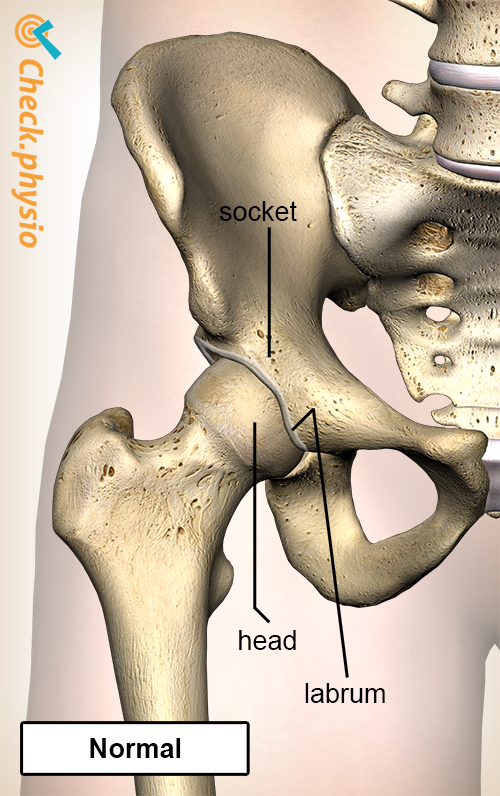
The hip joint consists of a femur head and a hip socket. The head and the socket are covered by a thin, smooth layer of cartilage that ensures that both parts of the joint can glide over each other. Along the edge of the hip socket is a ring of connective tissue called the labrum. The labrum keeps the femoral head better positioned in the hip socket.
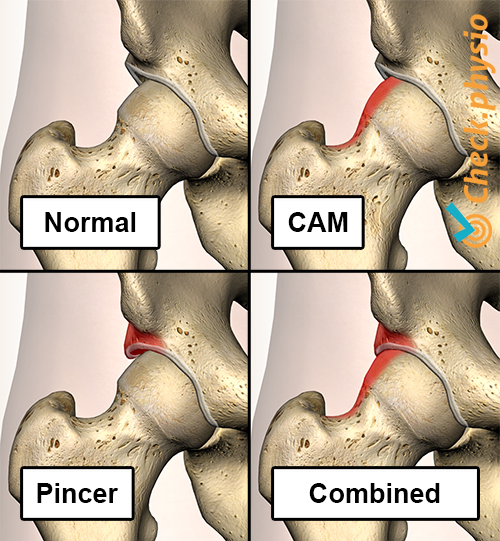
Normally, the hip joint consists of a rounded femoral head and a deep hip socket. The curve of the femoral head fits perfectly into the curve of the hip socket. With a hip impingement, the shape of the femoral head or the hip socket is unusual. This means that the head and the socket no longer fit together properly. As a result, the cartilage and the labrum can become trapped. We feel this as pain in the hip or groin.
There are three types of hip impingement. The different types describe the joint shape of the femoral head and the hip socket.
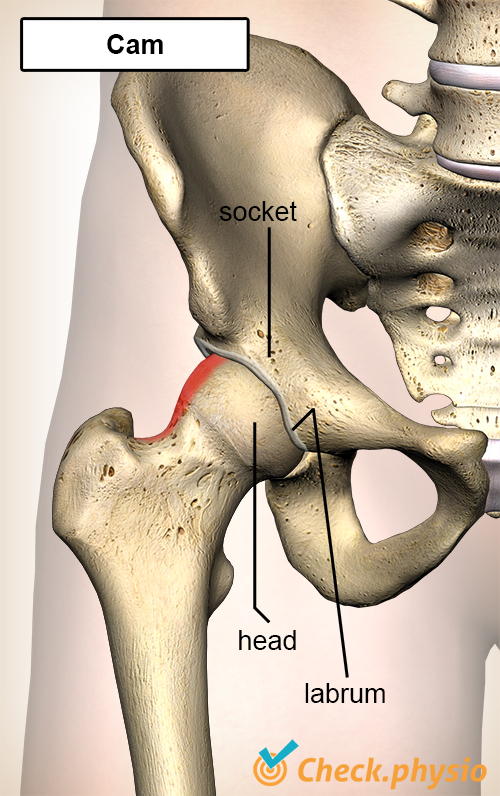
Cam impingement
In this case, the curve of the femoral head is too wide, so that it does not fit into the hip socket.
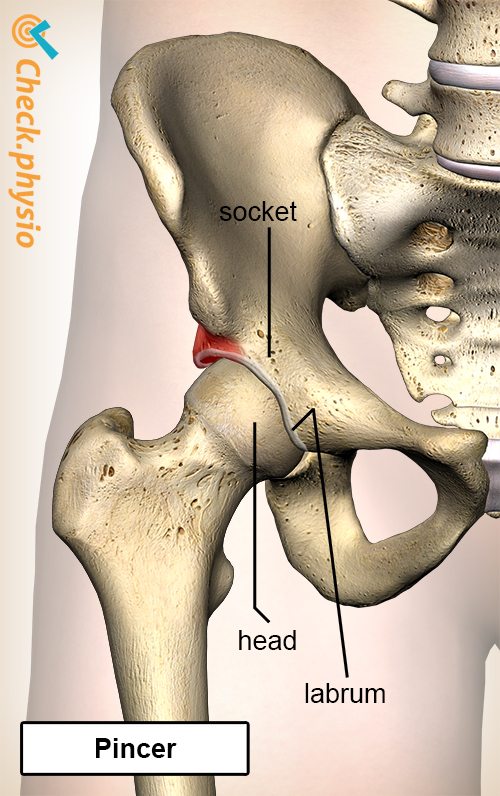
Pincer impingement
In this case, the hip socket has a defect. The edge of the hip socket sticks out too far, making the socket too deep. This may cause the femoral head to collide with the edge of the hip socket during movement.
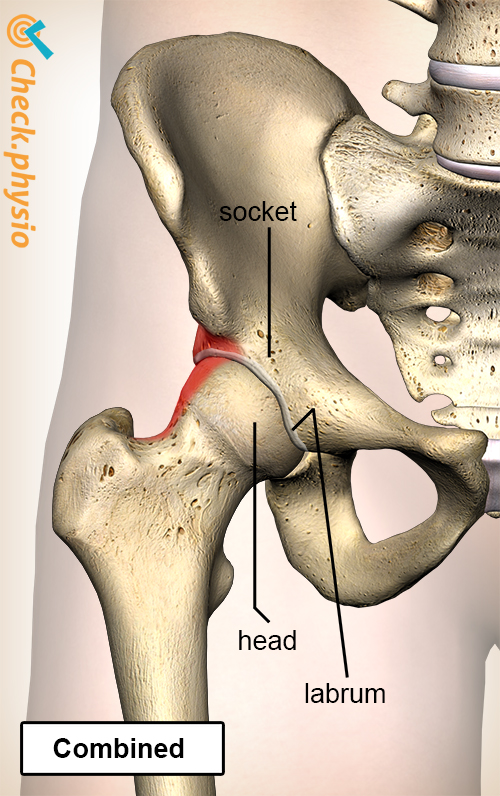
Combined (mixed) impingement
This is a combination of a cam impingement and a pincer impingement. Both anomalies are present.
The misalignment of the hip joint in itself does not cause any symptoms. However, if the misalignment causes damage to the cartilage or the labrum, symptoms may arise.
Damage to the cartilage or the labrum is caused by the femoral head and hip socket colliding frequently and subject to strong forces due to the misalignment. Because the hip joint is protected by the cartilage and the labrum, these get damaged first.
Cause and history
An abnormal shape of the joint is usually congenital. A change to the hip joint can also occur after a broken hip (hip fracture).
The symptoms usually arise as a result of repeatedly straining the hip in extreme situations. These extreme situations are most often seen during sporting activities where the hip is frequently rotated and a lot of force has to be generated.
Hip impingement is more often seen in:
- People aged 15-50.
- Top athletes or athletes who are training intensively.
- Sports requiring a lot of hip rotation (soccer, field hockey, golf, football).
Signs & symptoms
Hip impingement symptoms can remain dormant for years before they really come to the fore. In the first phase, when there is only minimal damage, a hip impingement will not cause any pain at all.
The symptoms that are seen with hip impingement are usually pain and/or stiffness in the groin region. In addition, stiffness or loss of mobility may develop in the painful hip.
Initially, the patient only experiences pain when the hip is moved to the end position or after strenuous (sports) activities that irritate the hip joint. After some time, the symptoms occur more often, for example, during light activities such as sitting or walking.
Major symptoms are restrictions on the mobility of the hip joint. Rotations of the hip in particular are limited. In addition, the pain can be provoked by bending the hip and rotating it at the same time. This movement causes the damaged labrum or cartilage to be trapped.
Diagnosis
Treatment and recovery
After the diagnosis has been made, an appropriate treatment program is decided in consultation between the doctor, the physiotherapist and the patient. Initially, this may consist of reducing the weight-bearing of the hip by adjusting the activity level.
In addition, consideration should be given to possibly compensating the limited mobility of the hip by mobilizing areas around the hip. This will often include training certain muscle groups that protect the action of the hip.
If the activity level cannot be adjusted or if conservative (non-surgical) treatment does not reduce symptoms, surgery may be considered.
Exercises
Take a look at the exercise program with exercises for hip impingement.
More info
You can check your symptoms using the online physiotherapy check or make an appointment with a physiotherapy practice in your locality.
What can we improve according to you?
Let us know, your opinion is important to us.
Thank you for your feedback!
We will work even harder to improve the quality of Physiocheck.ca.
Did this information help you?
References
Magee, D.J., Zachazewski, J.E., Quillen, W.S., Manske, R.C. (2016) Pathology and intervention in musculoskeletal rehabilitation Elsevier, 2nd edition.
Magee, D.J. (2014) Orthopedic physical assessment Elsevier saunders: St. Louis.
Philippon, M.J., Brian Maxwell, R., Johnston, T.L., Schenker, M. & Briggs, K.K. (2007) Clinical presentation of femoroacetabular impingement Knee Surg Sports Traumatol Arthrosc. 2007-15:1041–1047.