
- Additional testing
- CT scan
CT scan
Computed Tomography
CT stands for computed tomography. A CT scan resembles a combination of an MRI scan and an X-ray. In a very short time, many different X-ray images are taken from all kinds of angles. A computer combines all these individual images into a 3-dimensional image.
This technique is particularly suitable for examining bones, lungs, abdominal organs, blood vessels, and the brain. To visualize other tissues, an MRI scan is more suitable. The doctor decides which type of examination will best reveal the problem.
How does a CT scanner work?
A CT scanner is a ring-shaped device with a table in front of it. The patient lies on this table. The ring moves around the patient and takes images. The aim is to remain as still as possible; otherwise, it will not be possible to take good images.
The CT scanner sends X-rays through the body, which are then detected on the other side. The different tissues in the body attenuate the radiation. Not all tissues allow the same amount of radiation to pass through. As a result, some tissues appear darker than others. In this way, a distinction can be made between the different tissues.
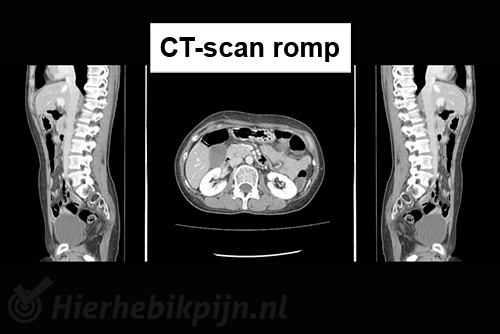
When the CT scanner has taken an image, the device shifts slightly so that an image can be taken from a different angle. This continues until images have been taken all the way around and thus a 3-dimensional image is created.
Although a CT scan takes only a few minutes, the body is exposed to a considerable dose of X-ray radiation. A possible pregnancy must be reported to the doctor in advance. The radiation is lower with a single X-ray and not an issue at all with an MRI scan.
The CT scan is evaluated by a radiologist. The patient receives the results later through their physician.
What can we improve according to you?
Let us know, your opinion is important to us.
Thank you for your feedback!
We will work even harder to improve the quality of Physiocheck.ca.
Did this information help you?