
- Physical complaints
- Inflammation
Inflammation
Inflammatory response
Inflammation is the body's response to damage to connective tissue. An inflammatory reaction is important for healing. This happens by replacing damaged tissue. Damage is not limited to large tears, fractures, or contusions but also includes smaller injuries. These can arise from overuse or microtrauma.
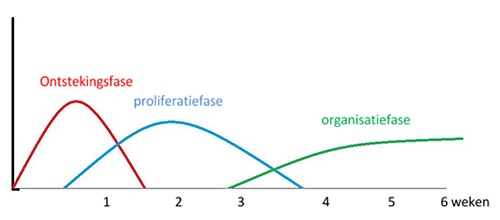
An inflammatory reaction progresses through different phases:
- Inflammatory phase.
- Proliferation phase.
- Organization phase.
Phase 1. Inflammatory phase
When tissue is damaged, even slightly, cell damage and blood vessel damage are the result. This triggers a process in which anti-inflammatory substances are produced. These anti-inflammatory substances are in the blood, which is why good circulation is very important. These substances stimulate healing.
The goal of the inflammatory phase is to clean the wound and activate cells for tissue repair. These processes make the nerve endings sensitive, which leads to increased pain.
During the inflammatory phase, the blood vessels dilate to provide the area with as much blood as possible. This can cause the area to feel warm and look red (if it lies close to the surface). The extra blood flow also causes the blood to secrete more fluid (plasma). This leads to swelling (edema). Swelling can be bothersome, especially if a joint is involved, as it can cause a limitation of movement.
The characteristics of an inflammatory reaction are therefore:
- Pain.
- Redness.
- Swelling.
- Warmth.
Phase 2. Proliferation phase (repair phase)
During the proliferation phase, tissue repair begins. The phases are not strictly separable and always overlap (see image). The proliferation phase starts fairly quickly (within a few days) after injury. The goal of the proliferation phase is to reduce the wound area and restore the wound based on function. This means that the tissue is prepared again for the function that will be required afterward.
The processes that ensure healing form new connective tissue. This connective tissue does not yet have the strength and function of the original tissue. As a result, the new tissue is still very vulnerable in this phase. It is important to guide the forming tissue toward the right function. In practice, this means you are not yet fully loadable during this phase, but you must move functionally.
For example, a muscle that has torn must regain its full length and strength during recovery in order to function optimally. If during this phase the muscle is not moved and is kept in a shortened position, the muscle will remain shorter than before. So the muscle must be moved through the proper length.
Strength training with additional weights to make the muscle stronger is not advisable in this phase because the tissue is still too vulnerable. Guidance during this process is therefore important.
Phase 3. Organization phase
The organization phase is intended to return the tissue to full function and thereby increase its load capacity. This occurs through strengthening of the tissue, ingrowth of nerve fibers, and reorganization of blood vessels. This also ensures that the new structure is recognized again by the central nervous system.
During this phase, rehabilitation is aimed at the function expected of the tissue. This depends on the person. The load demanded by a top athlete is very different from the load demanded by someone who is less active.
It can take 12 months before the connective tissue that is formed at the beginning becomes fully functional. Until then, changes at the microscopic level are visible.
This does not mean that the tissue cannot be fully loaded in the meantime, but rather that during these 12 months the new tissue adapts to the function that is required. The tissue should therefore be loaded maximally, but at the right time in rehabilitation to make it as strong as possible.
Risks
An inflammatory reaction is a very good mechanism of the body. Everyone, no matter how fit or healthy, undergoes the natural inflammatory reaction. The duration of the phases can differ due to the size of the injury and the individual. But everyone progresses through the phases. Good circulation ensures faster recovery because the anti-inflammatory substances can reach the damage more effectively.
If insufficient rest is taken during the inflammatory phase to allow the body to progress through this phase, inflammation persists. This is comparable to a cut on a finger: if it is pulled open every day, it will never heal optimally.
Anti-inflammatory medications are often prescribed if the inflammatory phase lasts too long and there are too many limitations in daily life. This is a good way to help the body get through the inflammatory phase. Because the pain decreases, the tissue can be loaded again, although the risk of overuse is very high. The tissue has been in the inflammatory phase for a long time, which has made it very weak.
If the pain is artificially reduced and mobility increases, there is a high risk that the tissue will be overloaded too quickly. This again causes overuse, which triggers another inflammatory reaction. Medication can therefore help, but it is very important that loading is gradually increased afterward.
Summary
| Inflammatory phase (phase 1) | |
|---|---|
| Characteristics |
|
| Do |
|
| Risks |
|
| Proliferation phase (phase 2) | |
|---|---|
| Characteristics |
|
| Do |
|
| Risks |
|
| Organization phase (phase 3) | |
|---|---|
| Characteristics |
|
| Do |
|
| Risks |
|
What can we improve according to you?
Let us know, your opinion is important to us.
Thank you for your feedback!
We will work even harder to improve the quality of Physiocheck.ca.
Did this information help you?
Related topics
- Asthma
- Back pain
- Bone fracture
- Bronchitis
- Bursitis
- COPD
- Cervical herniated disc
- Coughing up mucus
- Cracking joints
- Diaphragm pain
- Discopathy
- Emphysema
- Fatigue
- Flat feet
- Floating rib syndrome
- Fluid in the ankle
- Fluid in the knee
- Fracture
- Funnel chest
- Groin pain
- Heel spur
- Herniated disc
- High blood pressure
- High-arched feet
- Hip dysplasia
- Hypermobility
- Iliotibial band friction syndrome
- Impingement syndrome
- Incontinence
- Inflammation
- Knee osteoarthritis
- Lower back pain
- Lumbago
- Muscle Contusion
- Muscle Cramp
- Muscle Pain
- Muscle Strain
- Obesity
- Overuse
- Pigeon chest
- Pneumonia
- Polymyalgia rheumatica
- Referred pain
- Sarcopenia
- Scapula alata
- Sciatica
- Shortness of breath
- Spondylosis
- Sprained ankle
- Tendinopathy
- Tendon inflammation
- Torn ankle ligament
- Tremor
- Types of bone fractures
- Worn hip